I just realized Elon is the GOAT.
I realized how incredibly coherent, so ahead of us, doable, so brilliant Elon’s concept is of the future.
Here is my breakdown.
AI models today are so good they can do almost all tasks better than humans. We’ve reached this point already. Why does this matter? Speed, efficiency, quality and price will drive replacement of almost all cognitive work. It’s solved – just a matter of integration, which will grow faster than we expected. Elon happens to have one of the best LLMs with one of the best private data sources (Twitter) and massive data centers to power it. Not top notch like anthropic but let’s say frontier.
What’s left is physical labor, and he’s also been solving physical labor – transportation through robotaxis and general-purpose robots for everything else.
Nothing is accidental. To have robotaxis, you need real-world training. For training, you need cars with camera/sensor data. Tesla provided all this. Now autonomous vehicles are basically solved – mostly regulation left. Optimus is next, and Musk says Tesla will primarily be a robot company.
He’s not solving for cars or specific labor. He’s solving for everything.
Quick jump and I will connect the dots.
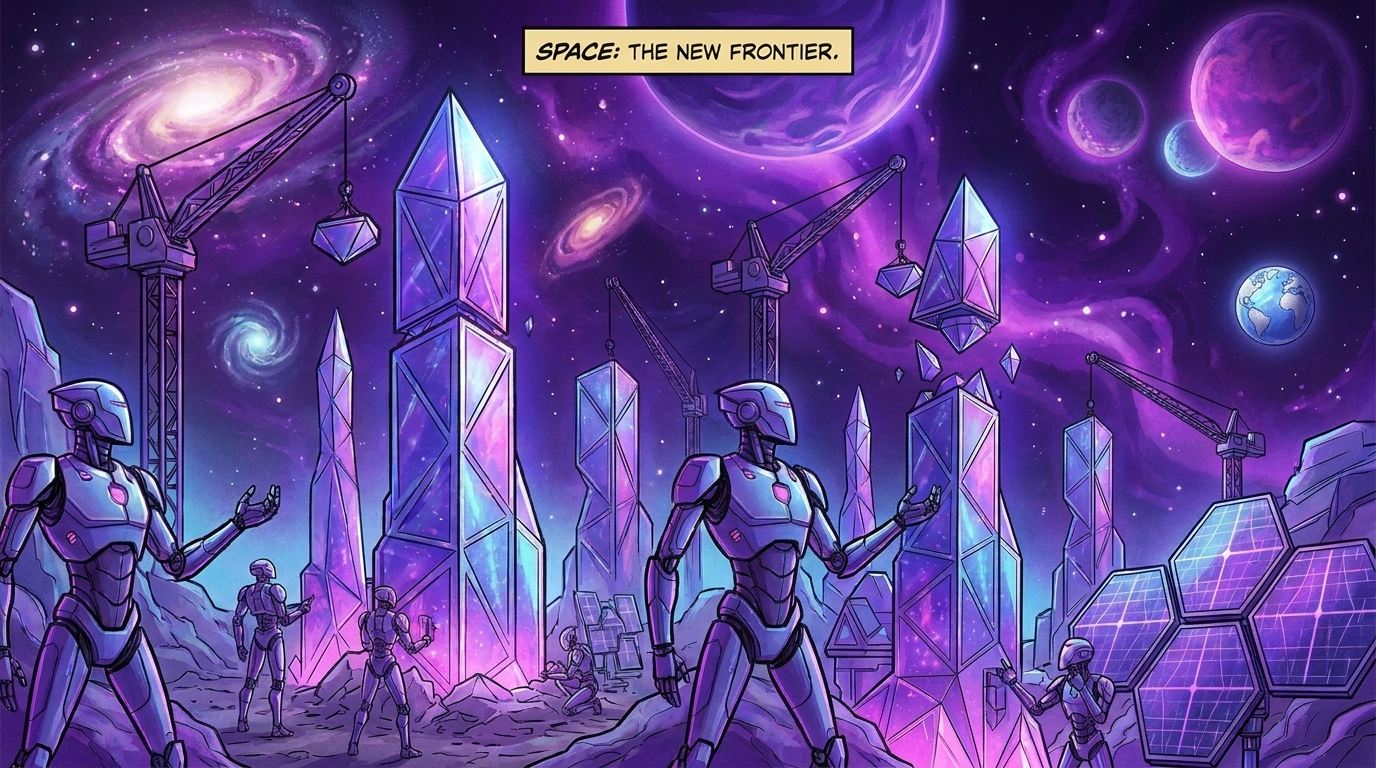
We can’t build a space civilization with humans – too dangerous, too expensive, too fragile. But we don’t need humans anymore. We’ve solved for both cognitive and physical labor. Robots are perfect for space by design.
Space throws radiation that kills humans – doesn’t affect silicon and metal. No oxygen needed. Extreme temperatures handled. Zero gravity that destroys human bones actually helps robots – less wear on joints, easier movement. They’re modular – swap parts, upgrade components, last decades instead of needing daily food and water.
Data centers in space make perfect sense now. You need massive computational power to coordinate thousands of robots building your space civilization. Space is cold – free cooling. Solar panels work 24/7 with no atmosphere – unlimited clean energy. No real estate costs, no regulations.
Those space data centers serve Earth too. SpaceX’s million satellites aren’t just internet – they’re distributed computing nodes. The same infrastructure coordinating space robots runs Earth’s AI operations. Twitter data feeds the AI managing both Earth factories and space construction.
Everything connects. Terafab iterates chips in days – straight to space infrastructure. Reusable rockets become routine supply runs. Optimus robots trained in Tesla factories learn skills for building in vacuum.
He’s not just going to space. He’s moving our entire industrial base where it can grow without limits.
Once you have this complete stack in space, something else becomes possible. Robots build the habitats, AI designs them. Perfect gravity through rotation, optimal atmosphere mix, controlled temperature and light – everything Earth got wrong, fixed by design.
But that’s just the start. AI improving at exponential rates, and that rate itself accelerating because AI makes the next AI faster. Extrapolate that trajectory and we start unlocking science that’s been pure fiction.
We’re already seeing hints – 3D printing organs, creating materials on demand, understanding biological systems at molecular level. Full control of physics means things like controlled fusion, maybe even teleportation. Complete understanding of biology means designing perfect organisms, controlling entire ecosystems. Not just copying Earth’s flora and fauna – improving them.
Up until now, Earth was our only choice because we lacked both understanding and control. Nature was better than anything we could build. But once AI pushes past a threshold, once we truly understand how matter and energy work at fundamental levels, we can engineer habitats that surpass Earth in ways we can’t imagine today.
The same way building in space with humans seemed impossible until we solved it with robots, creating better-than-Earth habitats seems impossible until AI unlocks the science. He’s not just building the infrastructure – he’s building the platform where these breakthroughs will happen. Away from Earth’s constraints, with unlimited computation and robot labor, discoveries that would take centuries happen in years.
I wonder how many other ideas in his head are already in motion that we don’t understand yet.